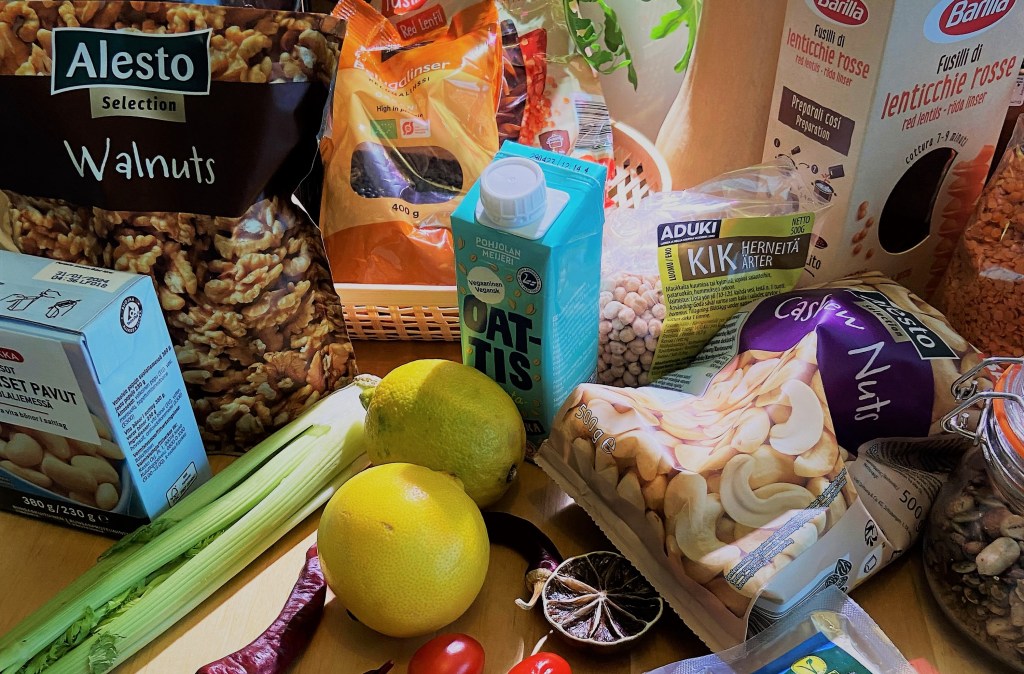
Firstly, as you might deduce from my “breakfast eggs” recipe, I haven´t really gone full vegan but I´m consuming on a diet that´s at least 75 % plant based. My reasons for eating plant based are environmental, health related and ethical (please check this out).
My stance on the use of animals outside of food production can be summarized as below:
I try not to buy cosmetics and personal care products that have been tested on animals, since dermatologic testing often is a viable option. I have worn out two pairs of Dr. Martens in about 5 years (I think they look good, Michelle from Derry Girls would probably say “cracker”), and although they are leather shoes I feel that wearing them until the leather cracks makes the matter ethically ok. I use and prescribe medication that have been tested on animals as there isn´t yet an viable option to animal testing regarding drugs.
Also, I believe that most people need medication that has been tested on animals more than most need animal-tested cosmetics. What one needs and what one wants might often be both qualitatively and quantitatively different, as well.
I try to consume about 80 % what I need and 20 % what I want. My reasons for this are environmental and financial. Buying mostly what I need saves me a lot of money, and what saves one money might be environmentally sustainable too. As long as the consumer gives the environmental effects of consuming at least the swiftest of thoughts.
Going vegan for environmental reasons*
Greenhouse gas, such as CO2 and methane, warms the planet by re-reflecting sun rays that bounces of the surface of the earth back down to warm the lower atmosphere and earth surface. This is a natural phenomenon that sustains life on earth through keeping the temperature suitable for humans, plants and animals.
However, human activity has in recent times emitted excessive amounts of greenhouse gas into the air, putting this delicate system off balance and giving rise to global warming. Too much greenhouse gas leads to much sun rays getting reflected back to earth, and rising temperatures lead to disruption of earth´s ecosystems, weather extremes such as drought and flood getting more frequent, extinction of species and disruption of water and air currents (such as the gulf stream).
Functioning ecosystems are important because nothing regarding life on earth is random. On the contrary, life on earth has evolved in response to quite stable conditions during thousands of years, and thus, every ecosystem sustains life trough adapting to local weather conditions. Disrupting the ecosystems that allow us to grow food, the systems that circulate the building blocks of life through a functioning circle of decomposition and reabsorption of plants is lethal. Evolution, the mechanism that eventually adapts a species to a changing environment won´t be able to keep up because the process of global warming is happening fast.
Some would argue that we are closing in on a tipping point, past which the disruption of the ecosystems of earth might be irreversible. This is actually quite reasonable, as ecosystems are highly fragile, often depending on a few key species (as the ecosystems of the north) or highly vulnerable to disruption of soil (as tropical rain forests). Some would say that we need to act now, that we need to change the way live (change might be gradual as well) in order to survive (or at least for life as we know it to continue relatively unchanged).
How your diet affects the climate
According to the BBC, 25 % of greenhouse gas emissions comes from food production. 58% of the greenhouse gas emissions stemming from food comes from beef and lamb (both are ruminants giving rise to CO2 as well as methane). As most diary comes from cows, cutting meat from your diet but keeping dairy lowers the climate impact (carbon footprint) of your diet about 20 %. Going full vegan lowers the climate impact about of your diet about 70 %.
As the human population on earth is growing, and the resources and ecosystems of the earth are exhaustible, a predominately plant based diet feeds more people as the toll on the ecosystem is lower. Farming plants requires less land and emits less greenhouse gas per calorie/gram of protein than farming meat. However, the climate impact and carbon footprint of different kinds of meat differs greatly.
Beef and lamb are the worst, cheese and farmed prawns are worse than pig meat and poultry. Chocolate and coffee are pretty bad as well, if grown on deforested land.
What can we do to stop global warming
I conclude we need to change our diets to contain more plants and plant based protein. We also need to burn less fossil fuel (oil, coal, natural gas and peat). We need to develop, scale and finance methods for binding and removing atmospheric carbon (such methods are already being developed). Lowering carbon emissions is the most important long-run step for sustaining life on earth as we know it. In the short term, considering the decades to come, it might not be enough, however.
*Before getting accepted to med school I studied biology and chemistry for about 2 years. I didn´t get me employed but it sure as hell gave me at least a basic understanding of global warming and carbon footprint.
I´m still a keen birdwatcher (mostly getting acquainted to a pair of very vocal ravens) and I love collecting and preparing plants for my herbarium.
 The Nutty Butcher
Leave a comment